
John W. Warner IV: Disclosure, Deep History, And The Dark Side Of The UFO Disclosure
Written by UAP Files - Jimmy

I don’t really know if this episode was an interview, a warning, or a guided tour through one man’s worldview.
Maybe it was all three.
John W. Warner IV is not the sort of guest who fits neatly into a five-minute “UFO witness tells all” format. He comes from a family tied deeply into American political, military and intelligence history. His father, John Warner, served as Secretary of the Navy and later as a United States Senator. His maternal grandfather was Paul Mellon, connected to the Mellon banking dynasty and, according to John, wartime intelligence circles.
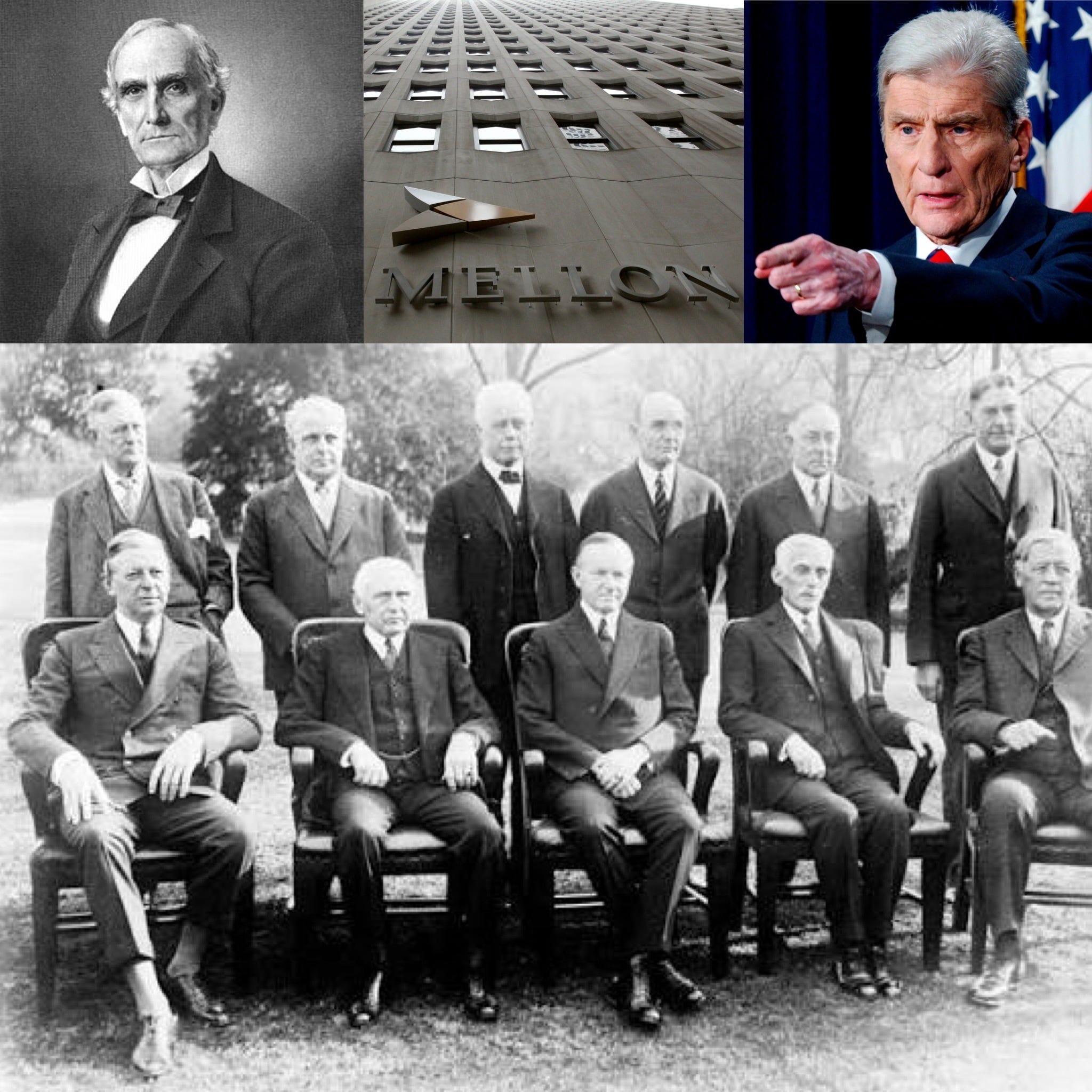
So when John talks about UFOs, he does not approach the subject like somebody who stumbled across it late in life through a few glossy AI generated YouTube videos.
He comes at it through history, war, intelligence, secrecy, elite power, black projects, occult traditions, and the uncomfortable possibility that the UFO subject is not really a separate issue at all.
In his view, it is woven into almost everything.
That does not mean every claim should be accepted at face value. Some of what John says is extraordinary. Some of it is difficult to verify. Some of it will make sceptics roll their eyes and some even hardened “believers” roll their eyes equally.
But that is also why I wanted to speak to him.
This subject has so many unknowns. So much secrecy, classification of data, misinformation and counter intelligence operations running alongside pockets of truth. It’s really, really complicated and confusing and who you can trust becomes increasingly complex.
Whether you agree with him or not, John represents a particular strand of the UFO conversation that is worth understanding. It is the strand that says disclosure is not just about lights in the sky, or pilots seeing strange objects, or whether a three letter agency has a recovered craft.
It is about power. And it is about history.
And it is about who gets to know what reality actually is. John also doesn’t really care if you agree with him or not. I find that incredibly refreshing and authentic.
John traces his interest in the subject back to childhood. He was born and grew up during the space race, surrounded by programmes like Star Trek, Lost in Space and The Outer Limits. Like many people of that generation, the idea of space, aliens and the unknown was embedded early.
But in John’s case, that childhood curiosity sat alongside something else: proximity to real political and military power. That’s quite rare.

He told me that as a child he would look through his father’s desk and saw references to UFOs and USOs — Unidentified Submerged Objects. He also said that by the age of fourteen he had got his father to acknowledge the existence of secret bases beneath the ice in Antarctica, connected, he said, to “space operations.”
Now, obviously, that is an enormous claim.
But what interested me was not simply the claim itself. It was the way John framed it. For him, UFOs were never just a pop culture curiosity. They were tied to military history, hidden infrastructure, classified technology and a world behind the world.
That theme ran through the entire conversation.
John spoke at length about his grandfather, Paul Mellon, and his involvement in wartime intelligence through the OSS, the forerunner to the CIA. He also talked about Alan Dulles, David K.E. Bruce, General Patton, occult libraries, secret societies, Nazi mysticism, the Thule Society, the Nazi Bell, and the idea that hidden knowledge has always sat in the background of military power.
This is where the conversation moved into territory that many people will find uncomfortable.
John argues that advanced technology, occult traditions and military secrecy are not separate historical lanes. In his view, they overlap. He believes that during and after the Second World War, the race for advanced technology was not simply about rockets, jet engines and atomic weapons. It was also about deeper principles: energy, gravity, consciousness, frequency, and technologies that the public still does not properly understand.
Again, that is not something I can verify. But isn’t virtually everything in the UFO/UAP and paranormal space hard to verify? It is a worldview that appears again and again in this subject.
The idea that the public version of history is incomplete. That recovered technology was hidden. That scientific progress has been managed. That the gap between what we are told exists and what actually exists is not thirty years, but hundreds.
John’s position is blunt: he believes we have had reverse-engineered UFO technology for decades.
He talked about anti-gravity, free energy, quantum computing, black triangles, exotic weapons, and craft capable of travelling extraordinary distances. He suggested that technologies now entering public life may have been used in classified programmes long before we ever saw them.
That is a familiar claim in UFO circles, but John presents it through the lens of geopolitics.
For him, the question is not simply, “Do aliens exist?”
The question is: what happens if multiple nations and private contractors have spent eighty years developing technology that is far beyond anything the public understands?
That is where the conversation became darker.
John believes we are in an arms race. Not just a conventional one involving ships, missiles, aircraft and drones, but an exotic technological arms race involving weapons and capabilities that most people would consider science fiction. He talked about China, Russia, the United States, the Five Eyes nations, and a hidden layer of military competition happening beyond public view.
He also warned that disclosure itself could become entangled with conflict.
That struck me because we often talk about disclosure as though it would automatically be a good thing. As though one grand revelation would unite humanity, dissolve borders, end war, and make everyone suddenly realise we are one species on one planet.
I would love that to be true. Honestly I would and a part of me still feels ultimately it’s the only thing that can really bring us together in this super fractured world right now.
Plus, I really, really want an anti-gravity flying DeLorean.
But what if disclosure does not arrive as a clean, inspiring, Steven Spielberg moment?
What if it arrives mixed with panic, power struggles, technological shock, financial disruption, military escalation and competing narratives?
John’s view is that governments have delayed the truth for so long that controlled disclosure may no longer be possible. He compared it to a steam boiler. The system is overheating, pressure is building, and officials are letting out little controlled bursts of steam to stop the whole thing exploding.
The problem, in his view, is that the boiler is still getting hotter.
That felt like one of the more useful images from the entire interview.
Because whatever you think about John’s more extreme claims, it is hard to deny that something has changed since 2017. The New York Times article, the Navy videos, congressional hearings, whistleblowers, AARO, NASA, legislation, pilots, intelligence officials, scientists and journalists have all dragged the subject back into public life.
But the process still feels strangely unsatisfying.
We get hearings. We get careful language. We get more acronyms. We get promises of better data.
We get officials saying there is no evidence of extraterrestrial technology, while others claim there are recovered craft hidden inside deeply buried programmes and talk of interdimensional beings. Some, with positions of power and authority tell us it’s real and it’s spiritual. Religious, even.
And the public is left in the middle, being told to take the subject seriously, but not too seriously.
That is the bit I keep coming back to.
If there is nothing there, why all the theatre?
And if there is something there, why are we still being treated like children?
John is highly critical of what he sees as managed disclosure. He believes the current process is too conservative, too controlled, and too connected to the very institutions that helped bury the subject in the first place. He mentioned Chris Mellon (his cousin from his mothers side), Luis Elizondo, Avi Loeb, Gary Nolan and others, and while he gave credit for helping bring the topic back to life, he clearly believes the public is still not being told the real story.
That is one of the tensions in this whole subject.
On the one hand, people inside the system may be the only ones able to move the conversation forward.
On the other hand, if the system hid the truth for decades, how much trust should we place in a disclosure process managed by that same system?
That is not an easy question.
John’s answer seems to be: very little.
Towards the end of the conversation, I asked him whether there was anything ordinary people could actually do. Citizen journalists, researchers, podcasters, people trying to make sense of all this from the outside.
His answer was more hopeful than I expected.
He pointed to the internet, the growth of independent media, podcasts, documentaries, public discussion and the fact that this subject can no longer be contained in the way it once was. Thirty-five years ago, the UFO conversation was much easier to marginalise. Today, it is everywhere.
Of course, that creates another problem.
More information does not always mean more clarity.
Sometimes it just means more mud in the river.
That phrase stuck with me too. Mud in the river. Because that is exactly what the UFO subject feels like at times. There may be something real moving beneath the surface, but the water is so polluted with hoaxes, disinformation, ego, grifters, government language, anonymous sources and online tribalism that it becomes almost impossible to see clearly.
And yet we keep looking.
Because somewhere beneath all of it, there is a question that refuses to go away.
Are we alone?
And perhaps more importantly: who already knows the answer?
John’s worldview is not a comfortable one. He does not offer the soft version of disclosure. He does not present extraterrestrial or NHI contact as a gentle spiritual awakening where everyone raises their vibration, buys a crystal, and suddenly the world heals itself with big hugs over a shared dinner table at Maccy’s.
He talks about war, secrecy, technology, corruption, elite power, hidden history, and the darker side of human nature.
At one point, he made the argument that too much of the disclosure movement focuses only on positivity. Love and light. Consciousness. Spiritual growth. Contact festivals. Higher beings. Ascension.
He is not dismissing all of that. In fact, he accepts that positivity and spiritual development matter.
But his point is that the universe requires balance. Light and dark. Hope and realism. The yin and yang. If we only focus on the comforting parts, we ignore the shadow. And if we ignore the shadow, we never really understand what we are dealing with.
That is probably the best way to understand this episode.
It is not a comfortable conversation. It is not neat. It is not something I would present as proven fact. But it is a conversation that forces you to think about the UFO subject in a much wider frame.
Not just as a mystery in the sky, but as a possible organising principle behind secrecy, technology, history, war, economics and power.
Maybe John is wrong about some of it.
Maybe he is wrong about a lot of it. I just don’t know. I hope he is wrong about much of it.
But maybe the deeper point still stands: if the UFO subject is real in the way many whistleblowers, witnesses and insiders suggest, then it was never going to remain confined to grainy videos and strange lights.
It was always going to lead somewhere much bigger. And maybe much more uncomfortable.
You can watch the full conversation with John W. Warner IV on the UAP Files Podcast below:
Support the UAP Files Podcast with a coffee, here 🙏
If knowledge is power, this speaks to that. So, by extension, secrecy is in and of itself evil and controlling.
Thanks to Jimmy for allowing me to speak my mind.