
UFOs: Does NASA Know?
Written by UAP Files - Jimmy

There’s a question that keeps coming up whenever UFOs are discussed: what does NASA actually know, and are they hiding it? On the surface it sounds simple, but when you really think about what’s being asked, it’s making a pretty serious claim. To say NASA “knows” and is hiding UFOs suggests that the agency, as a whole, is aware of non-human technology or off-world craft and is deliberately keeping that information from the public. That’s obviously a very high bar to clear.
NASA isn’t a small, secretive group. It’s a massive, internationally connected organisation with tens of thousands of employees, multiple layers of clearance, constant collaboration with other countries, and a lot of its work happening in public. Missions are livestreamed, data is shared, and people move in and out of the agency all the time. Trying to maintain a tightly controlled, centralised conspiracy across something that large would be incredibly difficult. But at the same time, it’s not quite accurate to say NASA knows nothing either.
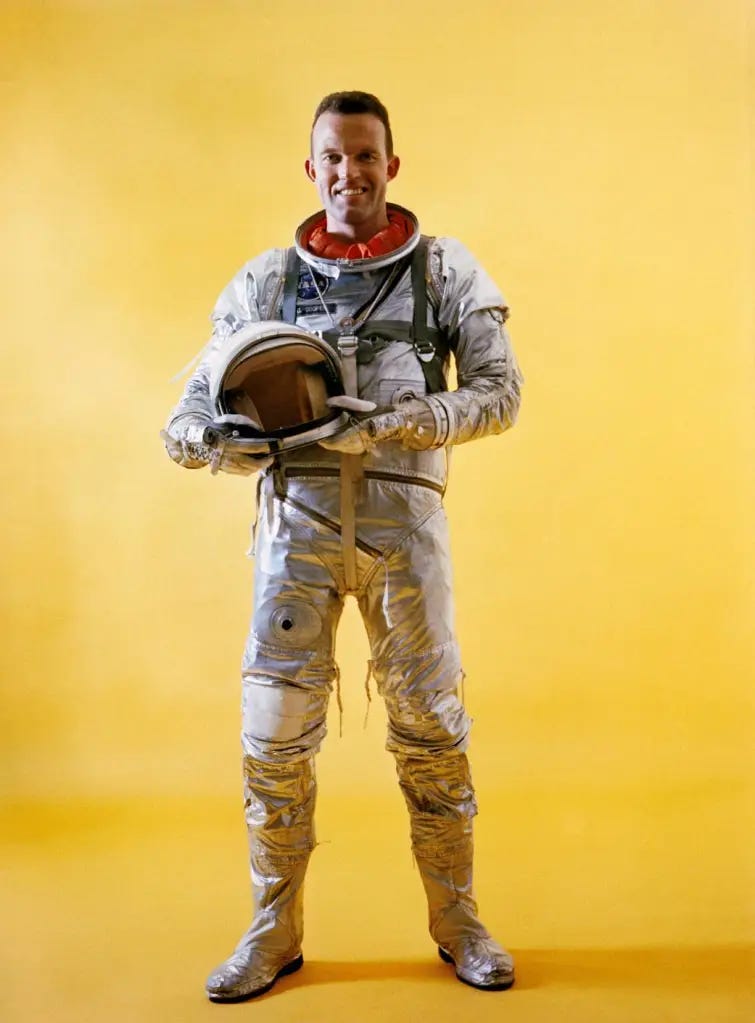
If NASA were completely in the dark, we wouldn’t have decades of strange (anomalous) observations to point to. Astronauts themselves have hinted at things they couldn’t fully explain - some outright stating we are not alone. Gordon Cooper, one of the original Mercury astronauts, was very direct later in life, saying, “I believe that these extraterrestrial vehicles and their crews are visiting this planet from other planets.” Edgar Mitchell, who walked on the Moon during Apollo 14, also spoke openly about the subject, stating that he was “privileged enough to be in on the fact that we have been visited on this planet.” Even Buzz Aldrin, while more cautious, described seeing an object during Apollo 11 that was “luminous” and “not a star,” something that has been debated ever since.
Several of those astronauts have seen UFOs prior to their spaceflights, whilst flying aircraft in their respective previous roles in the Air Force and as civilian pilots.
Gordon Cooper described an incident from the 1950s, when he was serving as a U.S. Air Force pilot at Edwards Air Force Base. According to his later accounts, a film crew working on a precision landing system captured footage of a strange craft.
He said the object:
Landed on dry lakebed terrain
Extended what appeared to be landing gear
Then took off again at high speed
Cooper stated that the crew brought the film to him, and he described it as a “disc-shaped object”. One of his more cited descriptions was:
“We had a film crew there… and this object landed, they filmed it, and then it took off.”
He also claimed that he sent the film up the chain of command to Washington, and that it was never returned or explained to him.
And Cooper isn’t only a small number of astronaut’s who have made these comments:
Astronaut Brian O’Leary said “we have had contact with alien cultures” and “their appearance is bizarre from any kind of traditional materialistic western understanding”.
Astronaut Deke Slayton said “I was flying my aircraft. I saw a saucer sitting on its edge, at a 45 degree angle. I didn’t have any gun camera film onboard unfortunately, otherwise i’d have shot some footage of it”.
Astronaut Edgar Mitchell said “there have been ET visitations, craft and materials and bodies recovered”.
Astronaut Buzz Aldrin said “I saw this illumination that was moving with respect to the stars. We were smart enough to say, Huston there’s a light out there that’s following us…”
So clearly, something has been seen. But seeing something unexplained isn’t the same as understanding it, and it’s definitely not the same as having a coordinated, institutional awareness of it.
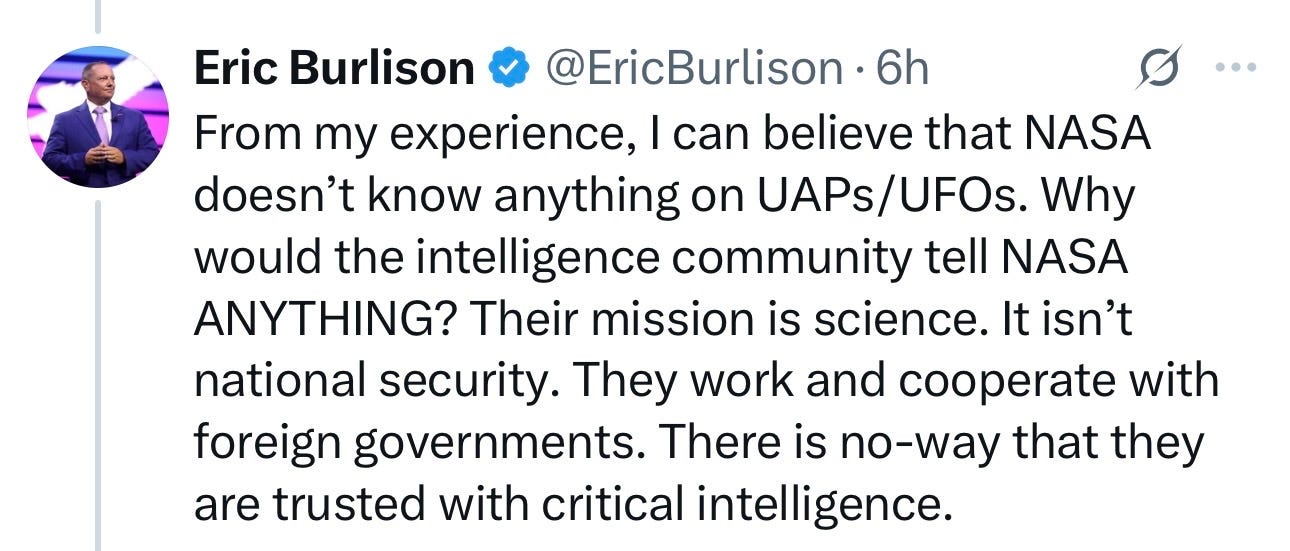
This is where a point raised by Congressman Eric Burlison becomes interesting and most significant to me. Why would the intelligence community share its most sensitive information with NASA in the first place? NASA’s role is scientific, and it works internationally, including with countries that aren’t always aligned with U.S. interests. It isn’t a national security agency. From that perspective, it wouldn’t make much sense to store or disclose highly classified material—especially something as sensitive as non-human technology—within an organisation that operates so openly.
That doesn’t mean NASA knows nothing, but it does suggest that if there are deeper secrets, NASA probably isn’t where they’re kept.
A more realistic way to look at this is through the idea of compartmentalisation. Historically, that’s how highly sensitive programs operate. The Manhattan Project is the classic example. Thousands of people were involved, but only a small number understood the full picture. Most were working on isolated pieces without knowing what they were contributing to. We see examples of that structure today. Even individuals like Col. David Grusch, who worked within the intelligence system, have said they struggled to gain access to certain information. If people at that level hit barriers, it’s hard to imagine that a typical NASA engineer, scientist, or even senior administrator would be fully read-into anything deeply classified. Especially political appointments who may be gone in a couple of years (sometimes months with this administration).
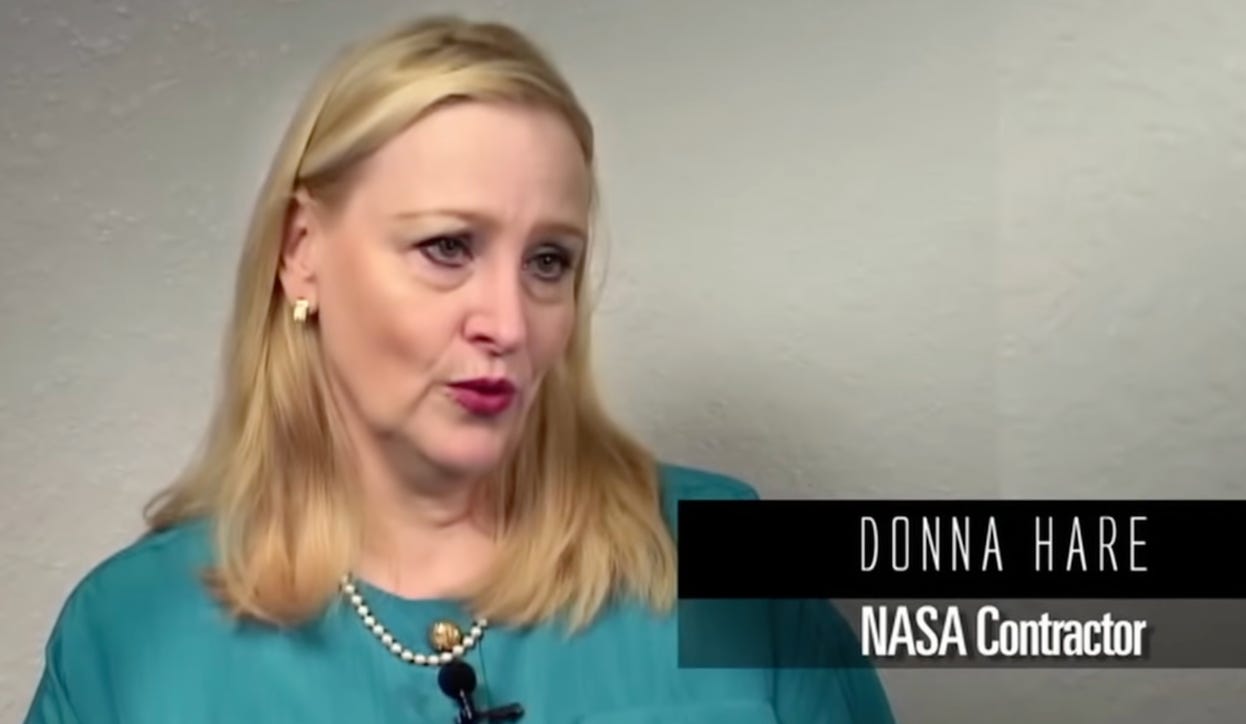
That brings us to the more unusual cases, like Gary McKinnon. McKinnon claimed that during his hack into NASA and U.S. military systems, he came across images of unidentified craft and references to “non-terrestrial officers.” What’s often overlooked is that he didn’t arrive at that idea in isolation, he has said that a NASA insider Donna Hare inspired him, and through her public communications had pointed him toward where certain information might be found. Whether or not you take his claims at face value, it fits an interesting pattern. And he claims he found it, where she said it was. UFOs being scrubbed from imagery and where those images were kept. Not NASA as a unified organisation sitting on a secret, but the possibility that certain individuals within or connected to it may have access to, or awareness of, anomalous data. An individual, or individuals.
If that’s the case, it points toward a model where knowledge is fragmented, held by small numbers of people, possibly in liaison roles or working alongside intelligence-related systems, rather than shared across the agency as a whole. That would align far more closely with how classified environments typically function.
NASA has also openly acknowledged that it sometimes cuts or delays live feeds and filters imagery, which isn’t controversial, it’s just practical. If you’ve invested billions into sensitive technology, you’re not going to risk exposing it on a public livestream. Surveillance satellites, private space tech launched with secrecy in mind via NASA and SpaceX as the travel agent…But it does raise an interesting question. The same systems and people responsible for filtering out known classified objects, like satellites, could also encounter things they don’t recognise. And if they do, what happens then? That part isn’t really clear.
If we step back and look at it realistically, it’s difficult to imagine that the biggest secret in human history would be stored in an organisation like NASA. If something truly world-changing existed, like advanced propulsion, non-human craft, or unknown energy systems, it would almost certainly be handled in a much more restricted way. Highly compartmentalised, tightly controlled, and limited to a very small group operating on a strict need-to-know basis. That’s how sensitive information is handled everywhere else, and there’s no obvious reason this would be any different.
It’s also worth considering that even senior leadership doesn’t automatically have access to everything. These systems don’t work on rank, they work on necessity. So when someone like a NASA administrator says they haven’t seen evidence of extraterrestrial craft, they may well be telling the truth. Not because nothing exists, but because they haven’t been given access to that level of information.
So where does that leave us? The most grounded answer sits somewhere in the middle. NASA, as an organisation, probably doesn’t have a complete, centralised understanding of UFOs. At the same time, that doesn’t mean nothing unusual has been observed, or that no one connected to NASA has ever encountered something anomalous. If there is deeper knowledge, it’s likely fragmented, compartmentalised, and sitting elsewhere. And importantly, not every gap in our understanding needs to be filled with a wide conspiracy.
There’s also a broader point here about how we treat the people trying to push for answers. Figures like Eric Burlison are in a position where they can ask questions from inside the system, which is relatively rare. But there’s already a tendency to turn on people in that position—criticising who they speak to, questioning their approach, or dismissing them too early. We’ve seen similar patterns before. Interest builds, expectations rise, and when progress feels slow, support starts to fade from both sides. I’ve seen that from Representatives like Moskowitz, Luna, AOC and, for that matter, virtually every Congressman and Woman who made the effort to attend and ask questions at the UAP hearing where Col David Grusch gave evidence. That doesn’t really help if the goal is clarity. Undermining the few people actively trying to get answers from within positions of power is more likely to slow things down than speed them up. You might argue that they’re just playing at it, that Tweeting is popular and it’s just riding the wave or popularity for self-serving purposes, but that doesn’t really matter even if true. People asking questions on our behalf, from a position of authority and influence, is surely better than no-one asking questions, no one holding hearings, no one reducing the stigma and going back 15 years to when this subject was just Facebook stories and the odd joke news excerpt scored with X Files music.
In the end, the answer to whether NASA knows about UFOs is both yes and no. They’ve seen things, they’ve recorded anomalies, and they’ve encountered data they can’t fully explain, or won’t fully explain. But the idea that NASA, as a single, unified entity, is sitting on the biggest secret in human history is much harder to support. A more realistic picture is less dramatic, but more believable. And that is a system built on partial knowledge, strict compartmentalisation, and a handful of people who may know more than they’re able to say.
Hello Jimmy,
Great resume, I hope you are recovering well. I assume we are getting closer to a disclosure by the Goverment's registering aliens.gov domain and some other endeavours being made, I wish the disclosure movement remembers and sticks to the empathic dynamic for everyones sake and "karma dynamic".
Best regards from Spain.
https://legionaus.substack.com/p/what-is-mondaloy-and-why-cant-you